529s as an Employee Benefit: The "How"
In a previous installment, we laid out the strategic case (the "Why") for offering 529 plans as an employee benefit. The natural next question: "okay, what does this actually look like in practice?" In other words, which options exist, how do they plug into payroll, what does it cost, and how do those state employer tax credits we keep hearing about actually fit in? That's why this next installment of 529s as an employee benefit covers the "How"—the menu of available options for HR and benefits professionals in the 529 space. And it's broader, more flexible, and easier to stand up than most employers expect.
Below: five distinct components of a 529 benefits package, the mechanics behind them, some of the pricing models you'll typically see, and three examples to help illustrate the ROI.
Five Key Ingredients of a 529 Employee Benefits Package
A "529 employer benefit" isn't a single product. It's a menu of potential offerings. We highlight the most common five below; most employers adopt two or three to start.
1. Payroll Deductions
A 529 payroll deduction is a logical place to start—a single payroll-system flip to make 529 savings automatic for employees.
How does it work? Simple. Working with a 529 benefits provider, the employer adds a post-tax deduction line to payroll. Employees opt in at any time (no need to wait for annual enrollment), dollars flow monthly from your payroll account into the employee's chosen 529 (or ABLE) plan, and the employee saves automatically. As every behavioral economist knows, this set-it-and-forget-it mechanism is how saving actually happens.
Per a SHRM survey, only 11% of HR professionals work at companies offering 529 payroll deductions, meaning simply turning it on puts you ahead of nine in ten peers. 529 benefits providers charge a reasonable monthly fee (fixed or PEPM) for this service.
2. Employer Matching or One-Off Contributions
The next option offers a double whammy, with the potential to both (1) boost employee saving rates materially, and (2) unlock lucrative state tax credits to the employer: it's employer contributions to employee 529 plans.
In this iteration, employers contribute directly to employees' 529 accounts (again, through the 529 benefits provider). This can be done in two main ways: (1) as a recurring match alongside payroll (e.g., $1-for-$1 up to a cap), or (2) as a milestone bonus (e.g., $500 on the birth of a child, a lump sum for employees with >5 years of tenure, etc.). Hadley recommends matching, as it incentivizes employees to save more for education themselves (just like a 401(k) match).
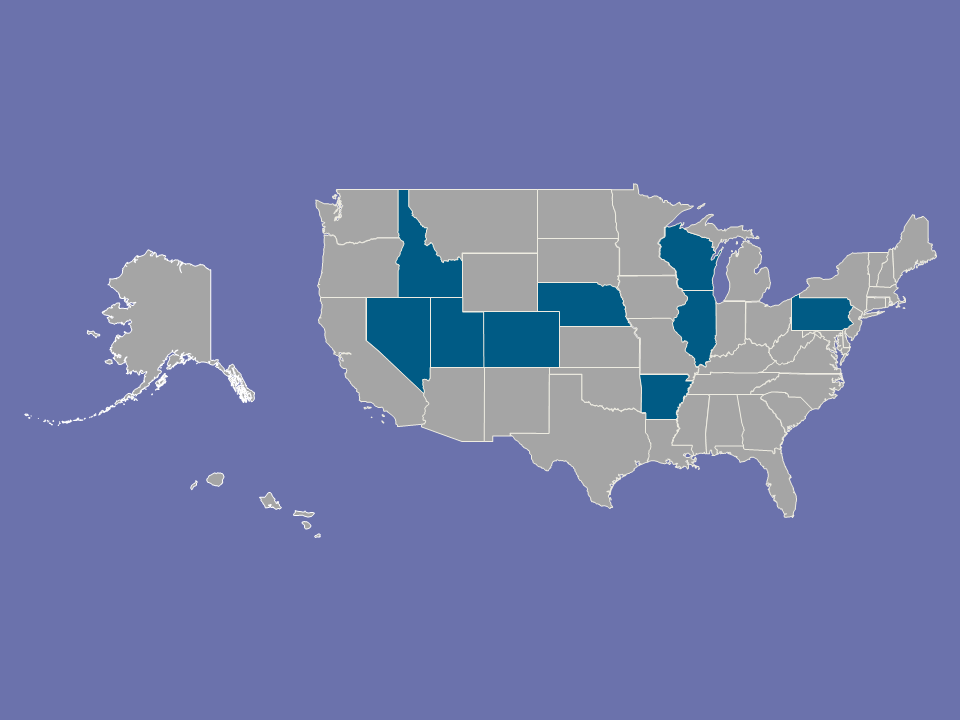
By contributing to their employees' 529 plans, employers potentially become eligible for state employer tax credits in the nine states currently offering them.

3. Financial Literacy Training
Most employees have never had a 30-minute conversation with anyone about 529s. They've heard the phrase, they vaguely know it has something to do with college, but that's it. The rest is fog. Recurring training—in-person or via video conference—close the knowledge gap and make it easier to take action. Topics typically include 529 mechanics, state-specific tax deductions, FAFSA interplay, qualified-expense rules (including the covering K-12 private tuition), and the new 529-to-Roth rollover.
Training is valuable on its own and dramatically increases adoption—in our own experience, employees who attend a session are several times more likely to enroll in payroll deduction the same week. Your 529 benefits provider is likely to include one-to-two trainings per year in your annual benefits subscription.
4. Personalized 529 Plan Recommendations
There are 50+ direct-sold 529 plans across the country, and most employees have no idea which one is best for their state of residence, tax bracket, and college timeline. Choosing wrong can leave thousands of dollars of state deductions on the table. No wonder confusion among plans is one of the leading reasons employees cite for never opening a 529!
Under SEC rules, only a registered investment advisor (RIA) can give individualized investment advice—including 529 plan recommendations. Your 529 benefits provider should be a licensed RIA so that they can tell each employee: given your specific circumstances, this is your plan.
Hadley's Find My 529 tool, along with our own RIA registration, delivers a personalized recommendation for each employee in about two minutes.
5. The Family Contribution App
The 529's structural problem: one family contributes (usually the parents) even though grandparents, aunts, uncles, and family friends would happily chip in for birthdays, holidays, and the increasingly common "please, no more battery-powered toys" requests. Until recently, getting Grandma's $50 check from Schenectady into a 529 in Connecticut was a paperwork errand.
The fix is a free mobile app that links to the employee's 529 and lets friends and family contribute the way they use Venmo. Some 529 benefits companies provide this (e.g., Hadley's mobile app), making 529 saving social and fun.
How the Mechanics Actually Work
Will your 529 benefits package be a 3-day lift, or 3-month project? A handful of operational details are at play.
Payroll Integration
When evaluating providers, the first question to ask is whether they integrate with your payroll processor. Your benefits provider should integrate seamlessly with most major payroll processors (e.g., ADP, Gusto, Paychex, Rippling, Workday, etc.). When set up correctly, employees self-select a contribution amount at any time, and it flows automatically (without manual file feeds or data entry). 529 contributions run as a post-tax deduction, not pre-tax like a 401(k). Unlike health insurance, a 529 benefit isn't tied to annual open enrollment. The "when should we roll this out?" question has exactly one answer: now.
Plan-Agnostic vs. Single-Plan
Ask your provider whether they are plan-agnostic, or single-plan. Some 529 benefits programs lock employees into a single state's plan (usually the home state of the employer). That's simple for the benefits team, but bad for any employee living in a different state with a better plan. Fully plan-agnostic programs are better for employees. Hadley's program is agnostic across every 529 and 529 ABLE plan in the country.
Tax treatment
Let's get to the real reason anyone opens a 529: tax breaks! There are so many at play that we had to break it down into multiple bullets (and that's a good thing).
Employer's federal return: Employer matching dollars are deductible compensation under IRC §162, just like any other tax-deductible expense. Any fees paid to your 529 benefits provider are federal tax-deductible as well.
Employer's state corporate return: There are two categories of employer state tax benefits: First, employer matching generates a state corporate tax credit (in the nine credit states). For example, Nebraska's 25%-up-to-$2,000 is the most generous cap; Wisconsin's 50%-up-to-$800 is the highest percentage. Outside the nine special states, employer matching dollars (and 529 benefit provider fees) generate state income tax deductions (where state income taxes apply). Note: where applicable, employers generally have to choose between taking the state tax credit or the state income tax deduction. In Nebraska for instance, the credit and deduction are mutually exclusive on the same contribution dollar. That said, the tax credit generally wins out.
Employee's personal state return: Some states allow the employee to deduct 529 contributions from their personal state income tax. This only applies to the employee's own contributions, not employer-match contributions.
Employee's personal federal return: Employee 529 contributions are made post-tax at the federal level; however, the 529 itself grows tax-free for qualified education expenses, so the employee comes out far ahead as compared with putting post-tax dollars into a taxable brokerage account. Employer 529 contributions are considered taxable W-2 income to the receiving employee. But as we'll see below, mathematically the employee still comes out far ahead when their employer contributes to their 529.
What Does It Cost?
Pricing for 529 employer benefits typically falls into one of three buckets:
Fixed firmwide annual fee. A single fixed annual fee covering the entire program. Easiest to budget for; favors larger employers running multiple components.
Per-employee-per-month (PEPM). A flat fee per month per employee participating in 529 payroll deductions. Favors employers who want to try the benefit out, and pay only based on participation.
Per-transaction. Employer pays a processing fee per contribution actually processed. Results in highly variable costs from month-to-month. A rarer, more specialized structure.
Which is right for your organization? It depends on company size, expected participation, and which of the five 529 benefits options you're offering—a payroll-deduction-only program prices very differently from a full match + mobile-app + training rollout. For a quote tailored to your organization, contact Hadley's enterprise team.
The Math: Three Scenarios
Fair warning: this is a heavier section than most. If detailed math isn't your thing, skip to the bottom line. If you're looking to understand a bottoms-up, quantified ROI, stay with us(!).
First, some baseline assumptions for all three scenarios below: A 650-employee firm stands up a 529 benefits program. We assume a 35% participation rate in the benefit (228 payroll contributors), an $83 biweekly contribution per participant ($2,158/yr), a 10-year horizon, a 7% total investment return (3% dividends + 4% capital appreciation), and 25% / 15% / 7% individual marginal income / cap gains / state tax rates, respectively, unless stated otherwise. Where an employer match is offered, we assume a match of up to $1,500 per participating employee per year.
The three scenarios below vary where the employer and employees are based, between (1) California, (2) Nebraska, and (3) a blend of the two. We also depict a no-match scenario, as well as a $1,500 employer match, for comparison purposes.
Each scenario below shows both (1) the employee-side value (own contribution savings, plus net 529 value from any match after personal income tax) and (2) the employer-side reclaim (federal deduction always, state tax credit OR deduction depending on state).
Let's go!
Scenario A: California—no state credit, no individual 529 deduction
First assume our employer and all employees are based in California (wah-wah). California is among the worst-case states for employee 529 tax mechanics—no individual deduction (as our California 529 deep dive explains), and no employer tax credit. Our no-match case lands at a total tax savings of ~$2,440 per employee over 10 years (federal cap gains and income tax savings). Not bad for a barely noticeable, biweekly payroll deduction!
Add in a $1,500/yr match, and that jumps significantly. The match compounds tax-free to a year-10 portfolio value of $21,450 (or $16,650 in portfolio value net of taxes), resulting in a total value per employee of ~$19,090. On the employer side, the federal and state tax deductions drop the net cost to ~$1,052/yr per employee (versus the nameplate $1,500 match).
Scenario A: California | 10-Year Value Per Employee |
Base case: own contributions, tax savings | $2,440 |
Year-10 portfolio from $1,500/yr match | $21,450 |
Less: employee income tax on W-2 match wages (~25%) | ($4,800) |
Net match value to employee | $16,650 |
Total employee value (10-yr) | $19,090 |
Gross employer cost (10-yr match) | $15,000 |
Less: federal §162 deduction reclaim (21% federal corp rate) | ($3,150) |
Less: CA 8.84% corp deduction (federal conformity) | ($1,326) |
Net employer cost, 10-yr | $10,524 |
Net employer cost per year, per employee | ~$1,052 |
Value-to-cost ratio | ~1.8-to-1 |
Headline: ~$1,052/yr buys ~$19,090 of value per employee over 10 years, a ~1.8-to-1 value to cost ratio.
Scenario B: Nebraska—25% state credit available
Now assume our company is based in Nebraska (woo-hoo!), arguably the strongest 529 tax credit state. Same employee math as California, except Nebraska also allows individuals to deduct 529 contributions from their state income taxes, so the no-match per employee value rises to $3,950 over 10 years. Add in the employer match, and that rises to $20,600.
On the employer side, the federal §162 deduction generates $3,150 in tax savings per employee over 10 years. On the Nebraska side, the employer earns the NEST tax credit of $375 per matched employee (25% of $1,500, capped at $2,000/yr) per Neb. Rev. Stat. § 77-1429 — and SEPARATELY deducts the same $1,500 match against Nebraska corporate income tax via federal conformity (≈$75 per employee per year at NE's ~5% corp rate). Combined 10-year reclaim per employee: $3,150 (federal §162) + $3,750 (NE credit) + $750 (NE corp deduction) = $7,650. Net employer cost: ~$735/yr per employee, a 51% discount to the $1,500 in matching contributions per year.
Scenario B: Nebraska | 10-Year Value Per Employee |
Base case: own contributions, tax savings (incl. NE state ded) | $3,950 |
Year-10 portfolio from $1,500/yr match | $21,450 |
Less: employee income tax on W-2 match wages (~25%) | ($4,800) |
Net match value to employee | $16,650 |
Total employee value (10-yr) | $20,600 |
Gross employer cost (10-yr match) | $15,000 |
Less: federal §162 deduction reclaim (21% federal corp rate) | ($3,150) |
Less: NE §77-1429 tax credit (25%, capped $2,000/yr) | ($3,750) |
Less: NE state corp deduction (~5% via federal conformity) | ($750) |
Net employer cost, 10-yr | $7,350 |
Net employer cost per year, per employee | ~$735 |
Discount vs. gross cost | 51% |
Value-to-cost ratio | ~2.8-to-1 |
Headline: ~$735/yr buys ~$20,600 of value per employee over 10 years, a ~2.8-to-1 value-to-cost ratio.
Scenario C: Multi-state hybrid—80 in Omaha, 148 in California
These days, it's more realistic to assume the firm is split across two or more states. Let's assume the 650-person firm is headquartered in California, with a satellite office in Omaha. Of the 228 contributing employees, 80 work in Omaha and 148 in California. The match is uniform firmwide, but the Nebraska credit only applies to the 80 Omaha-based contributors (Nebraska corporate tax is only owed on Nebraska-attributable income). The employer earns 80 × $375 ≈ $30,000 in Nebraska credits per year, ~$300,000 over 10 years.
For the employees, the tax benefits are identical to those in Scenarios A and B above (depending on where the employee is based).
For the employer, the tax benefits look like a blend of Scenarios A and B. The trusty federal deduction on contributions kicks in with identical value. California's 8.84% corporate deduction applies to the CA portion of the match (148 CA employees × $1,500/yr = $222,000/yr in CA-attributable contributions). Nebraska, separately, allows the match to be deducted against its corporate income tax via federal conformity (on top of the § 77-1429 tax credit), applied to the NE portion of the match (80 NE employees × $1,500/yr = $120,000/yr in NE-attributable contributions). Net-net, the employer is looking at a blended cost of ~$943 per employee per year, resulting in a blended per employee value of ~$19,700 over 10 years, a ~2.1-to-1 value-to-cost ratio.
Scenario C: Multi-State | Firmwide, 10-Year Value |
Contributing employees: Omaha office | 80 |
Contributing employees: California (HQ) | 148 |
Total contributing employees firmwide | 228 |
NE §77-1429 tax credit, per Omaha employee per year | $375 |
NE tax credits, firmwide annual | $30,000 |
NE tax credits, firmwide 10-year | ~$300,000 |
Federal §162 deduction reclaim, firmwide annual | ~$72,000 |
Federal §162 deduction reclaim, firmwide 10-year | ~$720,000 |
CA 8.84% state corp deduction on CA-attributable match | ~$19,600/yr |
NE ~5% state corp deduction on NE-attributable match | ~$6,000/yr |
Per-employee 10-yr value: Nebraska contributors | $20,600 |
Per-employee 10-yr value: California contributors | $19,090 |
Blended firmwide employee value (10-yr) | ~$4.5M |
Blended firmwide net employer cost per employee per year | ~$943 |
Blended value-to-cost ratio | ~2.1-to-1 |
This hybrid pattern—uniform benefit firmwide, partial state corporate credit—is the norm for multi-state employers, not the exception. Any company with operations in one of the nine credit states and one or more non-credit states has the same dynamics in motion.
The Bottom Line
A 529 employer benefit isn't a single product but a menu—payroll deductions, employer matching, financial literacy training, personalized recommendations, and (hopefully!) a mobile app for family contributions—in any combination. Even the simplest of the five (e.g., payroll deductions) put the employer ahead of 90% of peers. Adding a match costs real dollars, but partially pays for itself on the employer's corporate state tax return (particularly in the nine states with 529 employer tax credits).
To the employee, a 529 workplace benefit has significant tax value, but perhaps more importantly, incentivizes educational preparation and sets families up for intergenerational wealth transfer. A 529 benefit tells your talent "we're rooting for you and your family."
In any state, 529 benefits make mathematical sense to the employer and to employees. And if you have operations in one of the nine 529 employer tax credit states (Arkansas, Colorado, Idaho, Illinois, Nebraska, Nevada, Pennsylvania, Utah, and Wisconsin) the deal is even sweeter.
We hope this demystifies how 529 benefits can work. To explore Hadley's enterprise 529 benefits suite, visit Hadley's Employers page or write us at AskHadley@gohadley.com.
More on employer 529 benefits in upcoming installments of this series.
//
Questions? Contact us at AskHadley@gohadley.com. We're always open to feedback, suggestions, or otherwise!
This article is provided for informational and educational purposes only and does not constitute investment, legal, tax, or accounting advice. Nothing herein should be construed as a recommendation or solicitation to buy, sell, or hold any security or to adopt any particular investment strategy or vehicle. The views expressed are those of the author as of the date of publication and are subject to change without notice. Any data, figures, or statistics are believed to be reliable as of the publication date but may become outdated. Hadley undertakes no obligation to update such information. Charts, graphs, hypothetical examples, and other visual materials are provided for illustrative purposes only and do not represent actual account performance. Past performance is not indicative of future results. All investments involve risk, including the possible loss of principal. Strategies discussed may not be suitable for all investors, and readers should consult their own professional advisers before making investment decisions. References to third-party websites or content are provided for convenience only. Hadley does not control or endorse, and is not responsible for, the accuracy or content of third-party materials. Advisory services are offered only pursuant to a written agreement and only in jurisdictions where Hadley is properly registered or exempt from registration. Additional information about Hadley is available in its Form ADV, which can be obtained upon request or via the SEC’s Investment Adviser Public Disclosure website: IAPD - Investment Adviser Public Disclosure - Homepage.