Understanding 529 State Tax Deductions: Free Money for Your Family
Updated: Sep 3
If you're thinking about saving for college, here's what many people miss: depending on where you live, your state might give you money back just for contributing to a 529 plan.
Yes, you read that right. Free money. Let us show you how it works.
What's a State Income Tax Deduction, Anyway?
Think of it this way: when you contribute to a 529 plan, some states say "thank you" by reducing the amount of income they tax you on. It's basically like getting a discount coupon for being a responsible parent.
Here's a simple example: Let's say you earn $75,000 a year and contribute $5,000 to a 529 plan. If your state offers a deduction, they'll only tax you as if you earned $70,000. The result? You get a bigger tax refund at the end of the year (or a smaller tax bill, if you owe taxes). That's called free money!
Show Us the Actual Savings!
Let's get specific with real numbers that matter to real families.
Important assumptions for these examples:
We're calculating the value of state tax savings over 18 years (birth to college)
We assume the tax savings are reinvested and grow at 7% annually (a conservative estimate, as the S&P 500 has historically delivered approximately 10% average annual returns with dividends reinvested according to The Motley Fool)
These examples show ONLY state tax savings—we'll discuss federal tax benefits separately below
Example 1: The Monthly Saver
Sarah contributes $250/month ($3,000/year). Sarah lives in a state with a 5% income tax rate that allows her to deduct 529 contributions. Here's what happens:
Annual 529 contribution: $3,000
State tax rate: 5%
Annual state tax savings: $150
Total state tax savings after 18 years (with 7% growth): $4,900
That's nearly $5,000 in state tax savings alone, assuming she reinvests those annual $150 savings and they grow over time. That could cover all textbooks for four years of college.
Example 2: The Consistent Contributor
Mike and Jenny contribute $500/month ($6,000/year). This couple lives in a state with a 6% income tax rate. Let's break it down:
Annual 529 contribution: $6,000
State tax rate: 6%
Annual state tax savings: $360
Total state tax savings after 18 years (with 7% growth): $11,800
They're getting $360 back each year, just for doing what they were already planning to do—save for their kids' education. When those savings are reinvested and grow, they're worth nearly $12,000. That could cover a full academic year of room and board at many colleges.
Example 3: The Aggressive Planner
The Chen family contributes $1,000/month ($12,000/year). They live in a state with a 5.5% tax rate. Here's what happens:
Annual 529 contribution: $12,000
State tax rate: 5.5%
Annual tax savings: $660
Total state tax savings after 18 years (with 7% growth): $21,600
That's over $21,000 in state tax savings alone. That could cover a full year of in-state tuition at many public universities.
The Important Details
When do you get this money back? You claim the deduction when you file your state income tax return, just like you would claim any other deduction. You'll see the benefit when you get your refund or owe less in taxes.
Are there limits? Yes, and they vary by state. Some states let you deduct $5,000, others $10,000 or more. Some even let you carry forward unused deductions to future years. Check your specific state's rules, or you can also consult the Tax Center in the Hadley Mobile App. One more thing: every state caps its deduction differently, and several cap it well below the $12,000 a year in Example 3 above—so the largest savings figures above are only achievable where your state's cap allows.
Do you have to use your own state's 529 plan? This depends on your state. Most states require you to use their own plan to get the deduction, but a handful of states let you deduct contributions to any state's 529 plan. Check out Hadley's Find My 529 tool to be recommended to your best plan, based on a number of factors (including your own state's tax treatment of 529 contributions).
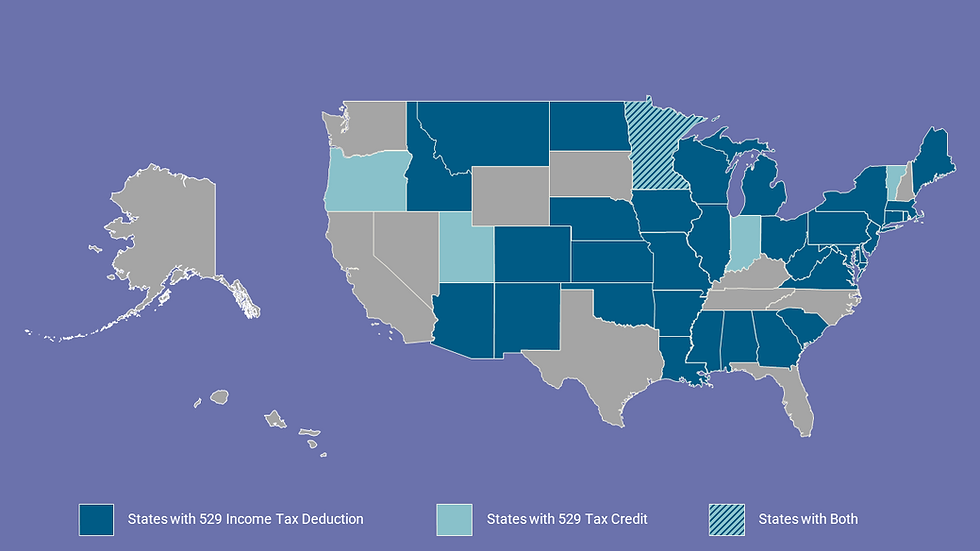
What about tax credits? Most states on this list offer tax deductions, but a handful—Indiana, Oregon, Utah, and Vermont—offer tax credits instead, and Minnesota lets you take one or the other—a credit or a deduction, but not both. The difference? A deduction reduces your taxable income, while a credit directly reduces your tax bill (generally more valuable dollar-for-dollar). We'll do a deeper dive on 529 tax credits in an upcoming post—stay tuned.
States That Offer 529 Tax Deductions
Here's the current list of states that offer state income tax deductions or credits for 529 contributions:
States with income tax deductions:
Alabama
Arizona
Arkansas
Colorado
Connecticut
Delaware (income limits apply)
Georgia
Idaho
Illinois
Indiana (tax credit)
Iowa
Kansas
Louisiana
Maine (income limits apply)
Maryland
Massachusetts
Michigan
Minnesota (tax credit or deduction—you elect one)
Mississippi
Missouri
Montana
Nebraska
New Jersey (income limits apply)
New Mexico
New York
North Dakota
Ohio
Oklahoma
Oregon (tax credit)
Pennsylvania
Rhode Island
South Carolina
Utah (tax credit)
Vermont (tax credit)
Virginia
West Virginia
Wisconsin
States with NO state income tax (so no free money, but also no income tax):
Alaska
Florida
Nevada
New Hampshire
South Dakota
Tennessee
Texas
Washington
Wyoming
States that DO have state income tax, but DON'T offer free money through 529 deductions:
California
Hawaii
Kentucky
North Carolina
Three States Where the Deduction Phases Out at Higher Incomes
Delaware, Maine, and New Jersey each added a 529 deduction within the last few years, but all three shut it off above an income threshold. If you live in one of these states, check the fine print before counting on the deduction:
Delaware: $1,000 for single filers / $2,000 for joint filers. Not available if federal AGI exceeds $100,000 (single) or $200,000 (joint). Contributions to the DE529 Education Savings Plan only.
Maine: $1,000 per beneficiary. Not available if federal AGI exceeds $100,000 (single) or $200,000 (joint or head of household). Contributions to any state's 529 plan qualify.
New Jersey: Up to $10,000 per return. Not available if gross income exceeds $200,000 (same threshold for single and joint filers). Contributions to the NJBEST 529 plan only.
Why This Matters More Than You Think
Let's put this into perspective. The examples above show state tax savings ranging from roughly $5,000 to $21,000 over 18 years, depending on assumed contribution level and state tax rate. And remember, these figures assume you reinvest your tax savings—if you simply pocket the money each year, the totals would be lower (though still significant).
But What About Federal Tax Benefits?
If you're like, wait, what about federal tax savings from 529 plans—then extra credit for you!
Here's the thing: the examples above only show state tax savings. While they are outside of the scope of this blog post, the federal tax benefits of 529 plans are actually much larger, because federal income tax rates are higher than state rates. When your 529 investments grow tax-free and you withdraw them tax-free for education expenses, you're avoiding federal capital gains taxes that could be 15% or more. We haven't quantified these federal savings here, but they significantly add to the total tax advantage of using a 529 plan (don't worry, we'll cover them in a future blog post, so stay tuned!).
The state income tax deductions we've been discussing are simply the cherry on top—immediate money back in your pocket every year for contributing. Your state helps determine which plan you should open for maximum "cherry on top" tax deductions—but everyone gets the same amazing federal tax benefits for 529 plans, regardless of the plan and their state.
Your Next Steps for Free Money from 529 State Tax Deductions
Check if your state offers free money through a 529 state tax deduction (see the list above)
Find the best 529 plan for your situation by visiting Hadley's Find My 529 tool, where you'll get a free personalized recommendation that factors in state tax benefits, fees, and investment options
Set up automatic contributions using the Hadley Mobile App so you never miss out on these savings and can easily track your progress
The best part? You're not doing anything complicated. You're just putting money aside for education and letting your state government thank you for it with a tax break.
The Bottom Line
State tax deductions for 529 contributions aren't glamorous, and they won't make you rich overnight. But they're one of those small financial moves that add up significantly over time. If your state offers 529 tax deductions and you're not taking advantage of them, you're essentially turning down free money.
And in a world where education costs keep climbing, every bit of free money helps.
Correction, September 3, 2026: An earlier version of this post listed Delaware, Maine, and New Jersey among the states offering no 529 tax benefit. All three offer state income tax deductions, subject to income limits; the lists and the map above have been updated. State tax rules in this post were re-verified on September 3, 2026 against state statutes and state revenue department publications.
//
Questions? Contact us at AskHadley@gohadley.com. We're always open to feedback, suggestions, or otherwise!
This article is provided for informational and educational purposes only and does not constitute investment, legal, tax, or accounting advice. Nothing herein should be construed as a recommendation or solicitation to buy, sell, or hold any security or to adopt any particular investment strategy or vehicle. The views expressed are those of the author as of the date of publication and are subject to change without notice. Any data, figures, or statistics are believed to be reliable as of the publication date but may become outdated. Hadley undertakes no obligation to update such information. Charts, graphs, hypothetical examples, and other visual materials are provided for illustrative purposes only and do not represent actual account performance. Past performance is not indicative of future results. All investments involve risk, including the possible loss of principal. Strategies discussed may not be suitable for all investors, and readers should consult their own professional advisers before making investment decisions. References to third-party websites or content are provided for convenience only. Hadley does not control or endorse, and is not responsible for, the accuracy or content of third-party materials. Advisory services are offered only pursuant to a written agreement and only in jurisdictions where Hadley is properly registered or exempt from registration. Additional information about Hadley is available in its Form ADV, which can be obtained upon request or via the SEC’s Investment Adviser Public Disclosure website: IAPD - Investment Adviser Public Disclosure - Homepage.


